
- Overview for Instructors
- Part One Review Session
- Part Two Review of Pollard Booklet
- Handout Materials
THE ENTERED APPRENTICE OVERVIEW FOR INSTRUCTORS
In the conclusion to his Critique of Practical Reason, Immanuel Kant wrote:
“Two things fill the mind with ever increasing wonder and awe, the more often and the more intensely the mind of thought is drawn to them: The starry heavens above me and the moral law within me.”
Unlike his contemporaries, Mozart and Goethe, Kant was not a Mason, yet the quote above speaks eloquently of the twin feelings of awe and responsibility which build within the mind and the heart of a man as he participates in the three degrees of Craft Masonry an awe of the majesty of the Supreme Architect and the sense of the Mason’s own responsibility as a builder.
In three experiences provided by the degrees, the Light of Masonic knowledge and faith dispels the darkness of ignorance. The light first illuminates our moral obligation within the brotherhood of man a position in which we are placed through the blessing and wisdom of God. The light next floods our minds as we realize the “fund of ingenuity implanted in man,” and once again the light fills our hearts as we contemplate the f final destiny of the builder.
The Masonic journey from darkness toward light has its beginning in the giant stride of the Entered Apprentice degree. In the brief span of this first degree, the foundations are laid. A full list of the Masonic elements which are presented in this degree, either directly or by implication, is astonishing.
Realizing how much is contained within the Entered Apprentice degree, there is a temptation for the Masonic instructor to attempt too much in reviewing the candidate’s experience. Such an attempt leads to lecturing rather than to discussion and may encourage indoctrination rather than exploration.
The educational process outlined in this manual is designed to present the new Mason with a brief review within the setting of the Lodge room, a less formal review of the Pollard Plan booklet, and the opportunity for discussion and exploration based upon handout materials.
There are several considerations which the instructor should keep in mind during the educational sessions:
1. The instructor should be alert to any opportunity which may arise which will serve to focus the candidate’s attention upon the sense of reality with which Freemasonry confronts the major problems and concerns of mankind. Masonry is concerned with the realities symbolized by both darkness and light, and it brings these two realities together, each in its own proper place, within the structure of the symbolic Lodge. This most important aspect of Freemasonry cannot be “taught” in the sense of preachment, but, as instructors, we can greatly assist the new Mason’s discovery of these fundamental considerations by helping him in his search for clear statements of Freemasonry’s goals.
2. The instructor should keep in mind that there are within the Entered Apprentice degree certain complex elements. Some of the complexity arises from the fact that the major symbols used in our ritualistic teachings have a wide spectrum of interlocking meanings. We all like things to be simple and neat, but the great symbols of mankind are not so, just as the human experience which they symbolize is not. (The point within a circle is a good example of such a complex symbol.) Moreover, our ritual contains references to ritualistic elements which, over the years, have been detached from their original place and significance and can only be appreciated through extended study. (The perfect points of entrance are a prime example.) While the instructor should not attempt to detail these complications and ramifications to the candidate, he should be aware that confusion is likely if the new Mason is thinking deeply about his Masonic experience. The instructor should strive to indicate, when such questions arise, the direction for future exploration on the part of the new Mason.
3. There are in the Entered Apprentice degree a number of ancient practices which have spiritual and special significance. The fact that these practices are both fundamental in symbolism and ancient in origin have led Masonic scholars to label these elements as “rites.” The instructor need not mention these “rites” by their technical names, nor need he belabor their ancient significance. He should, however, keep them in mind as he endeavors to assist the new Mason in finding the meaning of what took place in the first degree. A list of these “rites” along with some references is given below:
a. Rite of Illumination (Let there be Light) – Roberts, The Craft and Its Symbols, p. 1 and 13, Short Talk Bulletin (MSA), “Light” Sept. 1955
b. Rite of Circumambulation – Roberts, The Craft and Its Symbols, p. 20 and 31
c. Rite of Destitution – Tried and Proven (MSA) p. 30
d. Rite of Discalceation – Roberts, The Craft and Its Symbols, pps. 16, 30, Coil’s Masonic Encyclopedia, p. 207
e. Rite of Investiture – Roberts, The Craft and Its Symbols, p. 31
f. Rite of Salutation – Tried and Proven (MSA) p. 30
4. It should be remembered that the Entered Apprentice as a figure in Freemasonry is also a symbol (though this is not made clear until the third degree lecture). The following quote taken from the instruction plan called Tried and Proven is worth noting:
“He (the Entered Apprentice) represents youth, typified by the rising sun, trained youth, youth willing to submit itself to discipline and to seek knowledge in order to learn the great Art of Life, the real Royal Art, represented and interpreted by all the mysteries of Masonry.”
5. Finally, one of the most important features of the Entered Apprentice degree is the Tenets of our Profession as Masons, followed by the four Cardinal Virtues of Freemasons. Handout Sheet EA 5 provides a means for reviewing these foundational tenets and virtues of Freemasonry.
PART ONE REVIEW SESSION
Objectives: To provide the new Mason the opportunity to review the major events of the Entered Apprentice degree within the physical setting in which the experience took place. To provide a clarification of elements within the ritual. (This clarification will be continued during the review of the Pollard Plan booklet and in discussions using the handout sheets.)
Setting and Preparation: The review session takes place in the Preparation Room and the Lodge Room. Both rooms should be checked to see if they are neat and clean. The following items should be laid out in the Preparation Room:
- Slipper, hoodwink and cabletow
- Handout sheet (EA 1.)
The following items should be laid out in the Lodge Room:
- Lesser lights arranged
- Bible, square and compasses laid on altar
- Ashlars in place (if available). If the Lodge does not have ashlars, then a representation can be provided by using handout sheet EA 3.
- Working tools of the Entered Apprentice laid out in East.
- Copy or Charter Certificate laid out in the East.
- Handout sheet EA 3 and sheet EA 4.
Climate: The instructor or educational coordinator should endeavor to build an atmosphere which is informal. This section is intended to be a structured review, but the candidate should feel free to take his time and to ask questions.
EDUCATIONAL PROCESS
Outline:
I. In Preparation Room
- Beginning your own free will and accord.
- Questions asked by Junior Deacon Handout sheet (EA 1.)
- Items pointed out
- In the Lodge Room
- Hoodwink (darkness)
- Slipper
- Cable tow
- Altar
- Prayer
- A question of trust
- No danger
- Circumambulation
- Oldest of ceremonies
- The Sun symbol of life-giving light
- Light symbol of God’s blessing and eternal plan
IV. Obligation and Light
V. Great and Lesser Lights
- Arrangement of Greater Lights b. Arrangement of Lesser Lights
VI. Penalties
VII. Working Tools of Entered Apprentice
VIII. Apron
IX. The Lodge
a. Charter
b. Dimensions and universality
c. Supports
d. Ornaments
e. Jewels
X. The Northeast Corner
a. On a Masonic journey
b. Light to come
SUGGESTED TOPICS FOR REVIEW SESSION
(Note: The text below is not intended for memorization, but is meant to serve as a guide.)
(I) In the Preparation Room
There is no need for me to remind you that it was in this room that you began your Masonic experience as a candidate for the Entered Apprentice degree. I would, however, like to remind you that you began this Masonic journey of your own free will and accord because it is only by your own commitment that Freemasonry can become truly meaningful to you.
You were asked particular questions by the Junior Deacon. You may like to have a copy of these questions along with a list of qualifications for initiation to take with you (Sheet EA 1 and Sheet AC 1.) These articles you will also remember (point out a slipper, hoodwink and cable tow.) You learned that these articles have a symbolic meaning in fact, several closely associated meanings.
You will recall that you entered the Lodge in darkness, that you carried no minerals or metals either as weapons or wealth, and that you came neither naked nor clothed and without worldly distinction, for the Masons who awaited you were interested in your inner character and not your social position or your outward appearance. You entered the Lodge neither barefoot nor shod both as an indication of your serious intent and your humility. The. cable tow was also a symbol of your willingness to subject yourself to initiation so that you might enter into the tie of Masonic Brotherhood.
(II) In the Lodge Room and behind the Altar
Here you knelt at the Altar of Freemasonry for the first time while a prayer was given, asking that the Creator of the Universe might grant you Masonic wisdom and that through your Masonic experience you might be better able to act with brotherly love and to understand that which is true for now and forever.
You were asked a most important question. Do you remember what that question was? (Wait for response)
Having given this answer, you were assured that no danger lay ahead. Your trust was well placed and your immediate safety in the hands of a friend. And thus began your Masonic journey within this Brotherhood of men.
(Note: The instructor may feel it wise to further underscore this first symbolic presentation of brotherhood.)
(III) With the assistance of the Senior Deacon, you then circled the Lodge turning from East to West as the Sun rises and sets. At that moment you were partaking of one of the oldest rituals of mankind, the symbolic following of the Sun path and the celebration of light and life. The Sun, for Masons, is a symbol of a greater light, the light of that creative wisdom and love which created the Universe.
(IV), This celebration of light as a symbol of life, wisdom and God’s plan of creation was again dramatized following your obligation. Do you remember the nature of this dramatization and its special relation to you? (Response) This same ceremony also symbolized the commitment of the Brethren of this Lodge to assist you by both instruction and friendship in your apprenticeship, for your sacred promises had made you a brother.
(V) For the first time you observed the great symbols of Freemasonry in their proper arrangement for the Entered Apprentice degree. The principal instruments of the Craft, whose teachings you are now in the process of understanding, radiate their symbolic meaning to the Craft and especially to the Worshipful Master of this Lodge who has the special responsibility of the government of the Masons who gather here. For this reason we never walk between these symbols, when they are properly displayed upon our altar, and the Master’s station.
(Have the new Mason(s) arrange the lights for the Entered Apprentice degree with instructor assistance.)
Your first view of these principal symbols of Freemasonry in conjunction with the Volume of Sacred Law was lighted by the flames of the three Lesser Lights. (Point out their arrangement.)
You will remember that the three lesser lights are symbols of those regulating principles in Nature and of the necessary government of a society in which peace and progress are the goals and, in particular, in the society of Freemasons.
(VI) Before leaving the altar, I would like to call your attention to the penalties of your obligation. These penalties have been a part of Freemasonry ritual from the days when such penalties were grim realities. The old and terrible penalties are today symbolic only. However, a violation of your obligation still carries sobering consequences, including the loss of self-respect and the respect of your Masonic Brethren as well as the Fraternity at large. (Advance to the Northeast.)
(VII) You will recognize these as the working tools of an Entered Apprentice. No doubt you noticed how well the use of the tools by Masons who worked in stone was employed to instruct Masons who work in the building of character. (Briefly review the actual and symbolic use of the working tools while allowing the new Mason(s) to handle the tools. Be dramatic in demonstrating their operative use.) (Ref. Roberts, The Craft and Its Symbols, pps. 37-38; Maine Masonic Textbook, (pps. 24-25.) (Advance to East)
(VIII) Here, each of us has stood while the Worshipful Master presented us with the badge of a Mason, the Lambskin Apron, a badge which, because of the character and the actions of this Fraternity, is honored around the World. For me it was a moment I shall never forget, and I trust it was the same for you. (Turn the new Mason(s) to face the West.)
(IX) As an accepted candidate you were told that you would learn more about the symbolic lodge in which Masons meet. In the Entered Apprentice degree you were given this information. You learned that a Lodge must be furnished with the Holy Bible, the square and the compasses, whose Masonic teachings are the Great Lights within this Lodge. The Lodge receives its official right to exist and to work by means of a charter of which this is a copy (or certificate). (Show the new Mason(s) the copy of the Certificate of Charter. The instructor may wish to point out the interesting points concerning his own Lodge’s Charter.)
You will remember that the Lodge is said to be a special shape or form. (Observe response and instruct if necessary.) This form was anciently thought to be the shape of the World in which we have our human existence. The Masonry which we are to practice in the World embraces beliefs fundamental to mankind. In keeping with the far flung dimensions of the symbolic Lodge, the roof is the clouded canopy, the symbol of God’s overarching presence in which we hope to find ourselves by the practice of faith, hope and, most importantly, love.
It is important to remember that it is not walls which support this symbolic Lodge but rather the essentials of all man’s finest endeavors, namely, Wisdom, Strength and Beauty. (Reference: The instructor will find MacBride’s Speculative Masonry, pps. 83100, most helpful in answering questions on the Symbolic Lodge)
(Handout Sheet EA 3 may be useful in the following discussion.)
The symbolic Lodge is adorned with both Ornaments and Jewels, the latter being the jewels of spiritual worth, and not those of monetary value. Its ornaments, you will remember, are the Mosaic Pavement which, with its black and white tiles, reminds us of both the good and the agony which life can bring. The Border which surrounds it (do you remember its name?) symbolizes the blessings of God whose radiance is represented by the symbol of a Blazing Star. (Reference: Maine Masonic Textbook, p. 26.)
There are six jewels which enhance the Symbolic Lodge. Let us name them over: The Square, which teaches Morality; the Level, which teaches Equality; and the Plumb, that instrument which in everyday practice tells when walls are truly vertical and erect, which symbolically teaches the upright, the just and the honest life. To these are added the rough Ashlar and the perfect Ashlar (point out). The rough Ashlar is emblematic of man without knowledge, rough, and lacking self-discipline and proper training. The perfect Ashlar, square and finished, symbolizes the man which we all hope to become. The Trestle Board reminds us that God has communicated His wisdom and His will through His creation and His inspiration of men. Thus He has given us the plans for spiritual building. (Reference: Maine Masonic Textbook, p. 27. (Note: There seems to be little purpose in making a point of “movable” and “immovable” categories imposed upon the Jewels of the Lodge as this distinction itself, has proven mobile in the development of Masonic ritual.)
(X) Return to Northeast Corner
And now we return to the Northeast corner of the Lodge the place where you found yourself at the close of the Entered Apprentice degree. It is a place poised between the darkness and the light a place of beginnings in your Masonic journey toward the East, where the Light of Masonry shall gleam with increased brilliance in the Degree of the Fellowcraft.
(Handout Sheet EA 4 provides an opportunity to further familiarize the new mason with the layout of a lodge, the position of the officers and the jewels of their office. The instructor can judge best how much the new mason can absorb and how interested he is in this important consideration.)
PART TWO REVIEW OF POLLARD BOOKLET
A. REVIEW OF THE POLLARD PLAN BOOKLET
General Note to the Instructor: Repetition can be an important tool in mastering the principles of the Masonic degrees. However, repetition can also be deadly dull when not necessary. The instructor should use his own judgment as to whether certain elements in the following sections on the Entered Apprentice degree have already been covered sufficiently. Quite often additional meanings and personal significance’s dealing with the symbolic teachings of our ritual can be developed during the discussions sessions even when the same element has already been covered in the previous review. Again, this section is intended to take the form of a dialogue between the instructor and the candidate.
Objective: To provide the new Mason with the opportunity to explore the teachings of the Entered Apprentice degree and the material contained in the Pollard booklet with the help of a Masonic instructor.
I. Teachings of the degree pp. 12
II. The Apprentice in History pp. 23
III. Rights of the Entered Apprentice p. 3
IV. George Washington and other famous Masons pp. 34
V. Early prominent Masons in Maine p. 4
VI. Admonition to new Mason p. 4
NOTES AND POLLARD TEXT
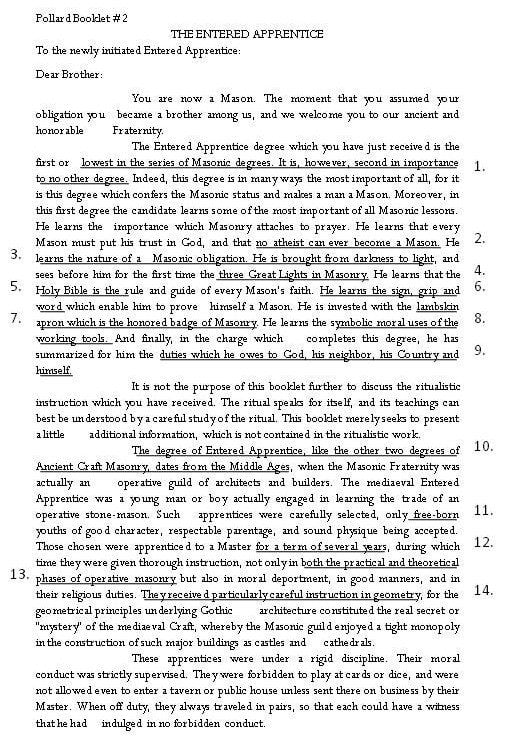
1. Note to Instructor: “Lowest” has an unfortunate connotation. Be sure that the line “is in many ways the most important” is stressed.
2. Instructional suggestion: Have the new Mason give examples of the fundamental importance of a belief in God as he views the teachings of the Entered Apprentice degree. (Reference for Instructor: Newton, Joseph Fort, The Religion of Masonry.)
Note to Instructor: The new Mason should understand that Freemasonry does not demand that the candidate profess a particular, dogmatic concept of God.
3. Instructional suggestions: Check with the new Mason to see if he has any question concerning the Entered Apprentice obligation. If vocabulary is a problem refer, him to the Handout of unusual words for this degree. (For general reference on obligation, see: Roberts, The Craft and Its Symbols, p. 26)
Note to Instructor: The instructor may feel that this subject has been sufficiently covered; however, its fundamental importance cannot be overstressed. It would be interesting to discover if the new Mason feels he has received light during his first Masonic experience. (Reference: Roberts, The Craft and Its Symbols, pp. 21-22; Short Talk Bulletin, “Light”, Sept. 1955.)
4. Note to Instructor: The Great Lights have been reviewed and can be reviewed again when using the handout sheet covering symbols. Perhaps the most important aspect to be considered here is the fact that the Great Lights symbolize moral principles which should become manifest in the Mason’s actions and personality. (Reference: Roberts, The Craft and Its Symbols, pp. 21 – 24.)
Instructional suggestion: Combine with consideration of No. 8, below. The honor and distinction involved in the apron arises from the actuality of our profession as Masons.
5. Note to Instructor: Again the candidate should understand that the Holy Bible is considered the Volume of Sacred Law within those Grand Jurisdictions where the Christian Hebraic religions predominate. (Reference: Newton, The Religion of Masonry p. 71; Coil’s Masonic Encyclopedia, pp. 51-52
6. Note to Instructor: Instruction and practice in giving the sign, grip and word is the responsibility of the brother assigned to help the new Mason with his. lesson. However, asking the new Mason how he is progressing in the learning of his lesson would be an indication of the instructor’s interest.
7. Note to Instructor: The symbolism of the Lambskin Apron should be reviewed. (References: Maine Masonic Textbook, p. 25; Roberts, The Craft and Its Symbols. p. 31.) As in the case of the meaning of the Great Lights, the distinction and honor of the Masonic Apron, as far as the World is concerned, and to a great degree among Masons, must reside in the degree to which the Tenets and Virtues of Freemasonry shine out in the character of the individual Mason. (Sheet EA 5 provides a review of the Tenets and the Cardinal Virtues.)
Instructional suggestion: The review of the Badge of a Mason provides an excellent place to review the Tenets and Cardinal Virtues of our profession as Freemasons.
The Tenets represent one of the most eloquent passages in our ritual, and it would be advisable to use the ritual text. The text provides ample basis for discussion on how these Tenets may be put into practical and immediate practice. (Reference: Maine Masonic Textbook, pp. 2829; Roberts, The Craft and Its Symbols, p. 29.)
The text for the four Cardinal Virtues as it appears in present rituals has been unfortunately complicated by an attempt to fuse several elements. (Reference: Coil’s Masonic Encyclopedia, p. 241.) It would seem best to review the four Cardinal Virtues with out reference to the Perfect Points of Entrance. Should the question about the latter, about all the instructor can say at this point in the new Mason’s instruction is that this has been a matter of interesting speculation for Masonic scholars. (General reference of Tenets and Cardinal Virtues: Roberts,
The Craft and Its Symbols, pp. 2930; Jones, Freemason’s Guide and Compendium, pp. 9456; Instructor’s Handbook (Maryland), p. 8; Short ‘Talk Bulletin (MSA) ,The Seven Cardinal Virtues”, Aug. 1950.)
8. Note to Instructor: The Working Tools of an Entered Apprentice have been re-handled and briefly explained in the first section of this review session. There will be additional opportunity to review these in the use of the handout sheet on symbols. The instructor may wish to pause long enough to see if the new Mason has any thoughts on their application to his own life.
9. Note to Instructor: The Charge has a special place in Masonic ritualistic history, since it is one of the oldest forms of instruction of the Operative Craft. The charge given to the Entered Apprentice has some important instructions for the new Mason. An outline of the charge is included in the handout sheets and may be used at this time to review the basic statements and admonitions. (Handout Sheet EA 2.)
10. Note to Instructor: While it is not important to the new Mason at this time, the instructor should be aware that Masonic scholars widely disagree about the origin and antiquity of the ‘ three degrees and about the third degree in particular. (Reference: Jones, Freemason’s Guide and Compendium, Chap. 15).
11. Note to Instructor: The new Mason may have questions concerning the phrase “Free Born.” It may be worthwhile to mention briefly that this is another example of living Freemasonry’s retention of the old regulations which often give both wisdom and stability to modern Masonry. In many cases the older regulatory forms become symbolically important. The new Mason might be interested in relating this particular old requirement to the Biblical warning that “no man can serve two masters.” In any event, the reference allows the opportunity to mention the Ancient Charges and Old Regulations which await the new Mason’s future study. (Sheet AC 1, paragraph 3, can be utilized in considering this topic.).
12. Note to Instructor: The term of several years (not always a fixed requirement) indicates both the commitment and the scope of the ‘ skills which the Entered Apprentice had to demonstrate. As for the present, seven years from now, the new Mason will still be discovering new insights in the Entered Apprentice degree.
13. Note to Instructor: “Theological’, here refers to symbolic and mystical considerations as well as to a relationship with the church in the Middle Ages. Arguments have been made that there is no direct evidence that Operative Masons practiced any system of a symbolic nature, however, it seems more than likely that they did.
14. Note to Instructor: The mention of “Geometry” as the basis and essential science of Operative Masonry provides an excellent opportunity to aid in the preparation of ‘the new Mason for the Fellowcraft degree. He should look forward to discovering more about this close association between Geometry and Masonry in the coming degree.

15. Note to Instructor: It is interesting to note that the Entered Apprentice of today shares the experience of the Entered Apprentice of the Operative era in having to pass an examination. It is to be hoped that the new Mason will realize that Speculative Masonry calls for a high level of performance in its own right just as building in stone did in the past.
16. Note to Instructor: The meaning of “Free” in the term “Freemason” has been greatly discussed by Masonic scholars. (Reference: Jones, Freemason’s Guide and Compendium, pp. 147159.) The meaning given here is both meaningful and possibly correct.
17. Note to Instructor: The learning of the Entered Apprentice lesson is the task of the new Mason with the help of the brother assigned to help him. Again it would be helpful if the Instructor were to inquire how the memorizing was progressing.
18. Note to Instructor: Present Grand Lodge Regulations limit Masonic processions to funerals and attendance at religious services unless special permission is granted. (Reference: Constitution, Sec. 101, pp. 3738.) One reason for this is Masonry’s wise abhorrence of ostentatious show. This position may be difficult for the new Mason to appreciate in an era when “commercialism” is considered to be clever.
19. Warning to Instructor: We have been living in an era which has taken special pleasure in despoiling heroes in the name of “realism.” It is possible that this section of the Pollard booklet will not have the good result which was hoped. If the new Mason has been told or if he believes that Washington ‘padded his accounts at the expense of a struggling new country, he may not be very impressed by Brother Washington’s Masonic affiliations. The instructor, as a Freemason, should be greatly concerned with the “debunking” of values, the “putting down” of noble ideas, and the belittling of fine men. His best defense, however, is not argument, but through a thorough knowledge of the facts along with a true appreciation of human nature. (Reference: Roberts, G. Washington, Master Mason.)
20. Reference for Instructor: Peyton Randolph – Patriot, President of First and Second Continental Congress. Joseph Warren – Patriot and soldier, important member of the Boston Committee on Correspondence and leader at the Second Massachusetts Provincial Congress. Killed at the Battle of Bunker Hill. Henry Knox – Commander of Artillery under Washington and later Secretary of War. His holding of a large tract of land in Maine led to the naming of one of our counties. Edmund Randolf – Statesman, Attorney General under Washington and Secretary of State under Jefferson. John Marshall – Served in the Revolution and became Chief Justice of the Supreme Court.
ENTERED APPRENTICE LIST OF HANDOUT MATERIALS
SHEET EA 1
The Junior Deacon’s Questions
SHEET EA 2
Outline of the Entered Apprentice Charge
SHEET EA 3
Symbols of Entered Apprentice Degree
SHEET EA 3A
Questions on Entered Apprentice Symbols and Degree
SHEET EA 4
General Plan of a Lodge Room, Officers’ Jewels, and Officers’ Places
SHEET EA 5
The Tenets of a Mason
The Four Cardinal Virtues
SHEET EA 6
Vocabulary List for Entered Apprentice Degree
SHEET EA 1
I. Do you seriously declare upon your honor, before these witnesses, that, unbiased by friends and uninfluenced by mercenary motives, you freely and voluntarily offer yourself a candidate for the mysteries of Masonry?
II. Do you seriously declare upon your honor, before these witnesses, that you are prompted to solicit the privileges of Masonry by a favorable opinion conceived of the Institution, a desire for knowledge, and a sincere wish to be serviceable to your fellow creatures?
III. Do you seriously declare upon your honor, before these witnesses, that you will cheerfully conform to all the ancient established usages and customs of the Fraternity?
SHEET EA 2
I. Congratulations to you on becoming an Entered Apprentice.
II. “No institution was ever raised on a better principal or more solid foundation; nor were more excellent rules and useful maxims laid down than are inculcated in the several Masonic lectures.”
III. Three great duties
A. To God
1. never mention His name without reverence
2. implore His aid
3. realize that God is the author of all good
B. To your neighbor acting on the square
C. To yourself avoid all intemperance which might keep you from upholding the dignity of your profession as a Mason?
IV. Citizenship understanding the importance of proper government and law in the land in which you reside.
V. Watch your actions do not let prejudice or bias lead you into a dishonorable action.
VI. Freemasonry is not intended to interfere with your necessary vocation; however, your frequent attendance in lodge is earnestly recommended.
VII. Don’t get involved in pointless arguments over the importance and nature of Freemasonry.
VIII. Continue your Masonic studies.
IX. Keep the mysteries of Freemasonry in your heart.
X. Consider carefully if the Fraternity will be strengthened by the membership of any individual who expresses a desire to join the Order.

SHEET EA 3A
** FOR USE BY INSTRUCTOR WITH CANDIDATE ONLY **
1. Which figures represent the working tools of an Entered Apprentice?
2. Can you name the pillars shown in figure “a”?
3. What do these three pillars symbolize?
4. Which figures represent the furnishings of a lodge?
5. What is an indented tessel? Which figure includes an indented tessel?
6. Which of the furnishings of lodge is dedicated to the Craft?
7. What is the symbolic significance of. the central symbol in figure “d”?
8. Which figure represents the lesser lights?
9. What do the lesser lights represent?
10. Charity or love of one’s fellow man is represented in which figure?
11. Can you give the name for the two stones shown in figure “c”?
12. Can you give the significance of these two stones in your own words?
13. What does figure “g” teach in regard to a Mason’s life?
14. Which figure represents the badge of a Mason?
15. What in particular does this badge of a Mason represent?
16. Which figures represent the jewels of a lodge?
17. Are there any jewels of a lodge which are not shown on this sheet?
18. Where does the ladder shown in figure “k” symbolically lead?
19. Which figure has to do with two important patrons of Freemasonry?
20. Which figure represents a symbol of human life?
21. Which figure shows a symbol dedicated to the master of a lodge?
22. Which figure symbolizes a change in our lives which we all hope will take place? (Through our endeavors to improve our character.)
23. Which figure has to do with the proper use of time?
24. Which figure involves master plans for building?
Some additional questions not related to figures shown:
1. Can you give the tenets of your profession as a Mason?
2. What portion of your degree experience referred to parts of the human body?
3. Can you remember the symbols which represented the proper attitude of an Entered Apprentice in ancient times?
4. Do you remember any special instructions that involved various forms of written expression?
5. Can you give any reasons for orienting a lodge east and west?
6. What are the symbols of the Entered Apprentice’s spirit of freedom, fervency and zeal?
NOTICE: ANSWERS TO THESE QUESTIONS ARE NOT TO BE WRITTEN
ON THIS OR ANY OTHER SHEET
SHEET EA 4
General Plan of a Lodge Room, Officers’ Jewels, and Officers’ Places

SHEET EA 5
THE FOUNDATIONS OF FREEMASONRY
The tenets of your profession as a Mason are BROTHERLY LOVE, RELIEF, and, TRUTH.
 BROTHERLY LOVE. BROTHERLY LOVE.
By the exercise of Brotherly Love we are taught to regard the whole human species as one family the high and low, rich and poor; who, as created by one Almighty Parent, and inhabitants of the same planet, are to aid, support and protect each other. On this principle, Masonry unites men of every country, sect and opinion, and conciliates true friendship among those who might otherwise have remained at a perpetual distance.
To relieve the distressed is a duty incumbent on all men, but particularly on Masons, who profess to be linked together by an indissoluble chain of sincere affection. To soothe the unhappy, sympathize with their misfortunes, compassionate their miseries, and restore peace to their troubled minds, is the grand aim we have in view. On this basis we form our friendships and establish our connections.
Truth is a divine attribute, and the foundation of every virtue. To be good and true is the first lesson we are taught in Masonry. On this theme we contemplate, and by its dictates endeavor to regulate our conduct. Hence, while influenced by this principle, hypocrisy and deceit are unknown among us; sincerity and plain dealing distinguish us, and the heart and tongue join in promoting each other’s welfare and rejoicing in each other , s prosperity. |
 RELIEF.
 TRUTH.
CARDINAL VIRTUES
The four Cardinal Virtues are TEMPERANCE, FORTITUDE, PRUDENCE and JUSTICE
Temperance is that due restraint upon our affections and passions which renders the body tame and governable and frees the mind from the allurements of vice.
Fortitude is that noble and steady purpose of mind whereby we are enabled to undergo any pain, peril or danger when prudentially deemed expedient.
Prudence teaches us to regulate our lives and actions agreeably to the dictates of reason, and is that habit by which we wisely judge and prudentially determine on all things relative to our present as well as our future happiness.
Justice is that standard or boundary of right which enables us to render unto every man his just due without distinction. This virtue is not only consistent with divine and human laws but is the very cement and support of a civil society.
SHEET EA 6
ACCORD (v) to agree, agreement
ARCHIVES (n) a storage place for documents and records
AVOUCH (v) to acknowledge
AWE (v) Reverential fear; amazement
BIAS (n) prejudice; influence or affect unduly
CENSURE (n) condemnation or blame
COUNTENANCE (v) approval; support; encourage; favor
COWEN (n) a person who lays brick or stone without mortar impersonating a skilled mason
DEBASE (v) to lower in character; degrade
DEMEANOR (n) behavior; manner
DENOTES (v) represents; signifies
DEROGATORY (adj.) lessening in good reputation
DIVINE PROVIDENCE God’s blessing
DEITY (n) God
DIVEST (v) to strip; dispossess; deprive
ECLIPTIC (n) apparent path of the sun
EMBLEMATICAL (adj.) serving as an emblem; symbolic
EMINENT (adj.) standing above others; distinguished
EQUIVOCATION (n) a deception arising from the use of a word
FERVENT (adj.) enthusiasm
FRUITION (n) realization; the yielding of natural or expected results
IMMEMORIAL (adj.) extending beyond memory of record
IMPLORE (v) to call to urgently
INCULCATE (v) to teach; to impress upon the mind
INDENTED TESSEL (n) the skirt work around the lodge originally; a chord tied in lovers knots and having tessels emblematical of the ties of brotherhood
INESTIMABLE (adj.) above price; very valuable
INTEMPERANCE (v) lack of moderation especially in the use of alcohol
INVIOLABLE (adj.) that which must not or can not be violated
INVIOLATE (adj.) pure; unbroken
INVOKING (v) to call on for aid or protection
MAXIM (n) a brief statement of a practical principle
MENTAL RESERVATION (n) the unexpressed qualifications of a statement that would, if uttered, effect or alter its meaning so as to violate its truth
PRECEPT (n) a prescribed rule of conduct or action
RASHNESS (adj.) acting without forethought
REPROACH (v) to bring disgrace upon; blame, discredit
SUPERFLUITY (n) wastefulness; intemperance
TOKEN (n) a visible sign; evidence
TRANSGRESS (v) to break the bounds of; sin; exceed
ZEAL (n) enthusiastic devotion